
If you have ever tried to maintain a daily personal budget in India, you are probably familiar with this cycle:
- On the 1st of the month, feeling determined, you download a top-rated budgeting app or open a fresh Google Sheet.
- For the first three days, you religiously log every expense: ₹15 for tea, ₹60 for an auto ride, ₹240 for lunch.
- By day six, after scanning ten UPI QR codes on a busy Saturday, you forget to log three transactions.
- By day ten, your balance in the app doesn't match your actual bank balance. You feel overwhelmed, stop updating it, and abandon the app entirely.
You are not alone. In India's fast-moving digital economy, manual expense tracking is fundamentally broken.
In this guide, we break down why traditional daily expense managers fail, introduce the concept of "Safe-to-Spend Daily Pacing", and evaluate the best daily expense manager apps for Indian Android users in 2026.
⚡ Quick Verdict (tl;dr):
In an economy where you scan 10 UPI QR codes a day, manual typing always fails. Money Timeline is the only daily expense manager in India that tracks bank SMS and UPI debits automatically with 100% on-device privacy, while displaying your live Safe-to-Spend Daily Pace dial on your home screen.
Why Daily Expense Tracking in India is Different
Daily cashflows in urban and semi-urban India look drastically different from the Western markets that most budgeting apps are designed for:
- High Transaction Frequency: An urban Indian professional makes anywhere from 100 to 250 UPI transactions per month. Typing each one by hand represents hours of wasted friction.
- Micro-Debits: The majority of daily spends are micro-transactions under ₹100—street food, tender coconut, kirana items, delivery tips, and parking fees.
- Complex Multi-Account Ecosystem: Most salaried professionals maintain a primary salary account (like HDFC, ICICI, or Axis), a secondary UPI spending account, and two or three credit cards.
- Payday Desynchronization: While Western apps operate on calendar months (1st to 30th), Indian salary cycles often begin on the 25th, 28th, 30th, or 5th of the month.
To stay on track, you don't need another blank spreadsheet. You need an automated system that calculates your daily spending velocity in real-time.
The Solution: Safe-to-Spend Daily Pacing
Rather than staring at a daunting monthly number (e.g., "You have ₹45,000 left for the month"), psychological research shows that the human brain makes far better financial choices when presented with a single daily figure:
"You can spend ₹1,250 today and stay on track for your savings goal."
If you spend ₹800 today, your remaining ₹450 rolls over into tomorrow's budget. If you splurge ₹2,000 on dinner tonight, your daily limit for the rest of the week gently recalibrates downwards to protect your month-end rent and loan EMIs.
Safe-to-Spend Daily Pace Calculator
Calculate your exact daily safe spending limit after protecting your rent, EMIs, and savings buffer.
Top 5 Daily Expense Manager Apps in India (2026 Review)
1. Money Timeline — Best Overall for Automated Daily Pacing
Money Timeline is an offline-first financial timeline built specifically for the Indian UPI ecosystem.
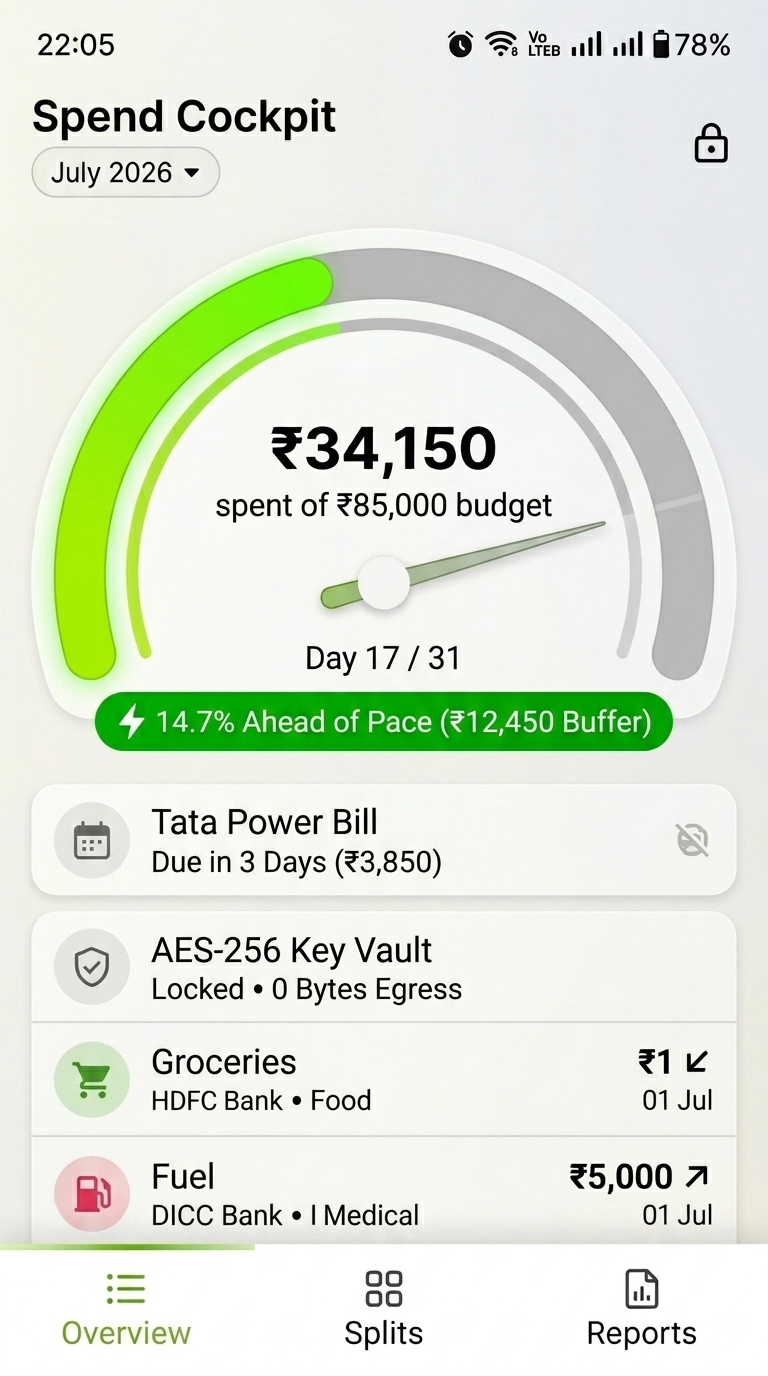
- How Daily Tracking Works: You never have to open the app after swiping your card or paying via Google Pay or PhonePe. Money Timeline's on-device engine parses your bank's transactional SMS alert locally, tags the merchant (Swiggy, Zepto, Uber, Chai Point), and updates your Safe-to-Spend dial in real-time.
- Key Differentiator: The live Pace Gauge. It tells you whether you are spending ahead of pace or on pace, and projects your exact month-end balance.
- Privacy: 100% on-device SQLite database. No bank logins, no passwords, and zero data uploads. Read our full privacy breakdown: Is It Safe to Let an App Read Bank SMS?.
- Pricing: Completely free, zero ads, no loan offers.
2. Walnut / Axio — The Pioneer That Pivoted to Loans
Walnut was India's original automatic daily expense tracker.
- Pros: Introduced millions to the magic of bank SMS parsing.
- Cons: Walnut was acquired by fintech lender Axio and pivoted away from expense tracking into personal loans, line-of-credit products, and pay-later financing. If you want a distraction-free daily tracker, see our comprehensive migration guide: What Happened to the Walnut App? Best Offline Alternatives in 2026.
3. Spendee & Monefy — Beautiful UI, Heavy Manual Friction
Monefy and Spendee are widely praised for their clean, colorful pie charts and simple tapping interfaces.
- Pros: Clean user experience with visual category icons.
- Cons: Zero automation for Indian payment rails. Every single ₹20 payment requires pulling out your phone, unlocking the device, opening the app, selecting a category, typing the number, and saving. By week two, manual fatigue causes over 80% of users to stop logging.
4. 1Money & Bluecoins — Powerful for Spreadsheets, Zero SMS Parsing
1Money and Bluecoins are popular tools among hardcore personal finance enthusiasts.
- Pros: Granular double-entry bookkeeping, custom sub-categories, and CSV exports.
- Cons: No native SMS auto-detection for Indian public and private banks. While powerful, the learning curve is steep and requires continuous manual maintenance.
5. Google Sheets / Excel Templates — Flexible, But Abandoned Quickly
Thousands of personal finance influencers offer downloadable Excel budget templates.
- Pros: Infinite customization and total formula control.
- Cons: Mobile data entry in spreadsheets is cumbersome. People rarely open Google Sheets on their smartphone while standing at a grocery counter, resulting in missed cashflows and inaccurate monthly figures.
Feature Comparison Matrix
| Feature | Money Timeline | Monefy / Spendee | 1Money | Google Sheets |
|---|---|---|---|---|
| Automatic UPI & SMS Detection | ✅ 100% Automated | ❌ Manual only | ❌ Manual only | ❌ Manual only |
| Safe-to-Spend Daily Pace Dial | ✅ Live Gauge | ❌ Static budget | ❌ No | ⚠️ Custom formula |
| Offline-First Privacy | 🔒 Encrypted SQLite | ☁️ Cloud sync | 🔒 Local file | ☁️ Cloud drive |
| Bill & EMI 30-Day Runway | ✅ Automatic | ❌ No | ⚠️ Manual reminders | ❌ No |
| Receipt Camera OCR | ✅ On-device ML | ❌ Manual attach | ❌ No | ❌ No |
| Couples & Family Hub | ✅ Shared Ring | ⚠️ Paid tier only | ❌ Solo only | ⚠️ Shared sheet |
| Effort Required Per Transaction | ⚡ 0 seconds | ⏳ 15–30 seconds | ⏳ 30 seconds | ⏳ 60+ seconds |
For families and couples wanting to track shared expenses together without leaking personal accounts, read: Best Family Budget Apps for Indian Households in 2026.
5 Golden Rules for Mastering Daily Expenses in India
- Automate the Small Spends: Never rely on memory to log ₹20, ₹50, and ₹100 purchases. Let on-device SMS parsing capture them automatically.
- Anchor Your Budget to Salary Day: Align your monthly cycle with the day your salary actually credits, whether that is the 28th, 30th, or 1st.
- Protect Fixed Bills First: Lock away your rent, loan EMIs, and insurance premiums on day one so your daily spending limit reflects true disposable cash.
- Inspect Weekly Pacing: Check your pacing gauge once every Sunday night. Adjusting your spending over 7 days is easy; catching up on the 28th is nearly impossible.
- Keep Personal Accounts Private: If managing household finances with a spouse or roommate, pool shared expenses while keeping personal discretionary accounts private to prevent budget resentment.
Final Recommendation: Reclaim Your Daily Peace of Mind
Managing daily money should not feel like an unpaid accounting job. By switching from manual data entry to automatic, private daily pacing, you can enjoy total clarity over your spending without typing a single number.
Try Money Timeline for Android and discover how effortless daily budgeting becomes when your app fills itself in.
Frequently Asked Questions
Most global expense trackers require manual data entry for every transaction. In India's hyper-active UPI ecosystem—where an average user pays 5 to 15 times per day for chai, vegetables, Swiggy, and auto rides—manually typing every amount causes 90% of users to abandon the app within two weeks.
Whenever you scan a QR code or pay via Google Pay, PhonePe, or Paytm, your bank sends an instant transactional SMS alert. Automatic daily managers like Money Timeline read that alert locally on your phone, extract the merchant name and exact amount, and add it to your daily pace without requiring you to open the app.
Safe-to-Spend calculates the exact rupee amount you can spend each day until your next payday without overshooting your monthly budget. It automatically accounts for your fixed commitments—such as loan EMIs, rent, SIPs, and credit card dues—so you never accidentally spend money earmarked for bills.
Yes. Money Timeline includes an instant Quick-Add widget and floating button for cash purchases, as well as an on-device receipt scanner that uses machine learning OCR to capture paper receipts in under two seconds.
Download the 2026 Indian Household Budget Planner
A structured CSV template calibrated for Indian families: 50/30/20 monthly buckets, SIP investments, loan EMIs, and UPI daily discretionary tracking.